
From Reactive to Predictive: How Big Data Is Transforming Nursing Practice
Healthcare is overflowing with data. Every shift, nurses chart assessments, vital signs, lab results, and care interventions. Yet for years, much of that data was reviewed only after something went wrong.
Falls were analyzed weeks later. Infections were discussed in monthly reports. Patient deterioration was investigated retrospectively.
That model is changing.
Big data and predictive analytics are shifting nursing from reactive documentation to proactive intervention. And that shift is redefining modern nursing practice.
The Problem With Retrospective Reporting
Traditional quality improvement relies heavily on historical data. We look at trends after the fact:
How many falls occurred last quarter?
What was the hospital-acquired infection rate?
How many rapid response calls happened this month?
While useful, retrospective reporting has limits. It tells us what happened, not what is about to happen.
In clinical practice, timing matters. Minutes matter. Hours matter.
By the time a deterioration is obvious, the patient may already be in crisis.
What Big Data Means in Nursing
Big data in healthcare refers to analyzing large volumes of clinical information to identify patterns and predict outcomes.
In nursing, this includes:
Vital signs trends
Nursing assessments
Laboratory values
Medication changes
Clinical documentation patterns
When aggregated and analyzed together, these data points can reveal subtle warning signs long before they become visible through traditional observation.
Instead of waiting for a crisis, nurses can receive early alerts.
Real-World Example: Early Detection Tools
One well-known example is the Rothman Index, which combines nursing assessments, vital signs, and lab results into a single patient acuity score.
Rather than reviewing dozens of data points separately, clinicians can see a trend line that signals deterioration risk.
This allows for:
Earlier rapid response activation
Faster physician notification
Proactive care planning
Prevention of ICU transfers
Early warning leads to early rescue.
From Documentation to Decision Support
For years, nurses have been exceptional data collectors.
Now, technology is helping us become data interpreters and decision influencers.
Predictive dashboards and real-time analytics allow nurses to:
Monitor risk levels dynamically
Identify high-risk patients
Adjust interventions earlier
Reduce preventable complications
This evolution enhances clinical judgment. It does not replace it.
The Impact on Patient Outcomes
Research consistently shows that early intervention improves:
Mortality rates
Length of hospital stay
Readmission rates
Complication rates
When deterioration is detected sooner, patients recover faster and more safely.
Predictive analytics strengthens what nurses already do best: monitor, assess, and intervene.
Skills Nurses Need for the Data Era
To thrive in predictive healthcare environments, nurses must develop:
Basic data literacy
Understanding of clinical scoring systems
Comfort with dashboard interpretation
Awareness of informatics principles
Nursing informatics is no longer a niche specialty. It is becoming a core competency.
The Future of Nursing Practice
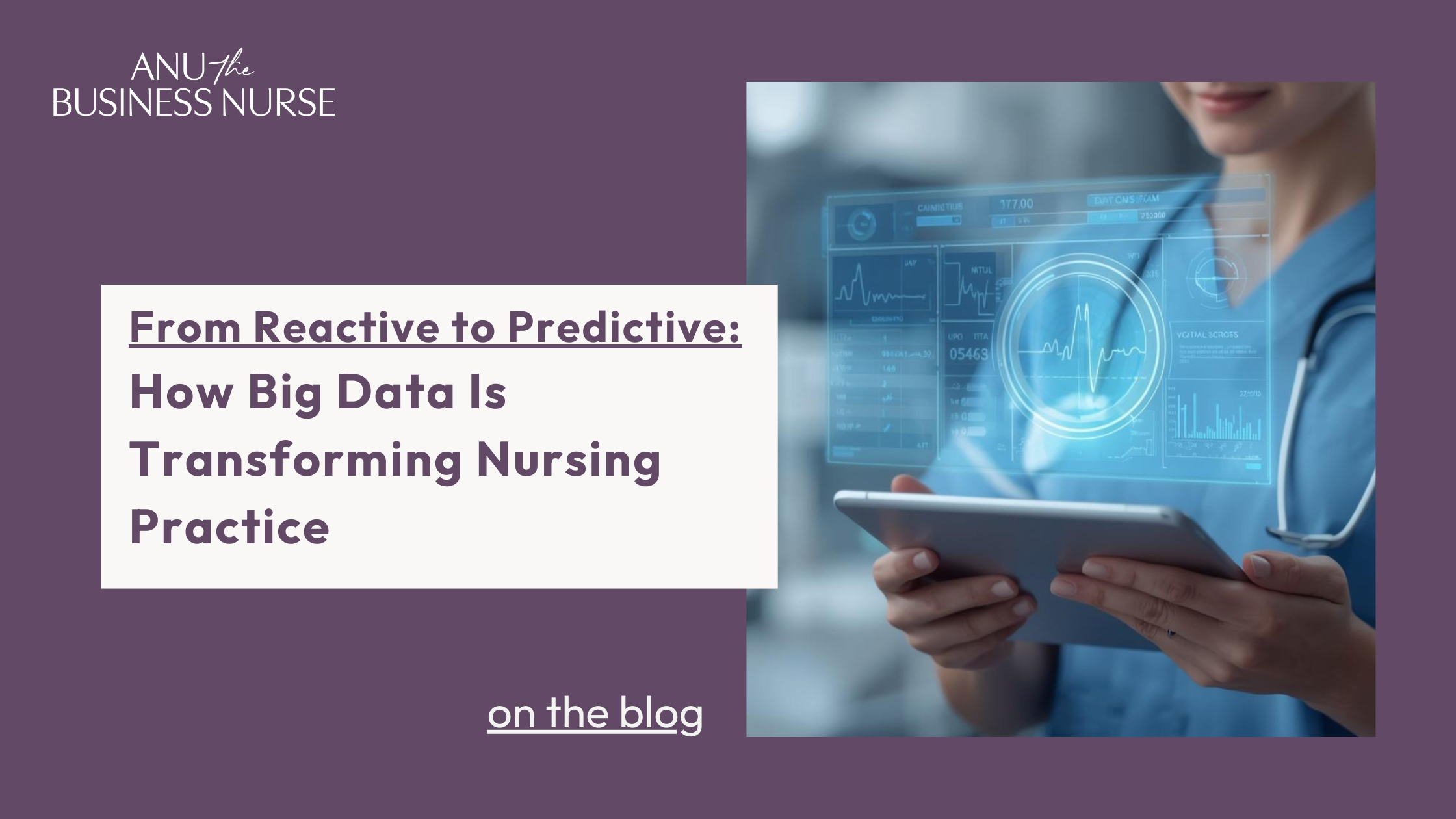
Imagine bedside dashboards updating in real time. Predictive models running silently in the background. Nurses empowered with actionable insights at the point of care.
This is not futuristic thinking. It is already beginning in progressive health systems.
The opportunity now is for nurses to lead the conversation.
Because if we do not shape how data is used in care, someone else will.
Final Thoughts
Healthcare is data-rich but often information-poor.
Big data analytics transforms raw documentation into meaningful insight.
For nurses, this shift represents more than innovation. It represents empowerment.
The future of nursing is not just compassionate. It is predictive, strategic, and data-informed.
